


The agar in Michelin star kitchens
For 4 centuries, the hegemony of haute cuisine was French, the recipes of its chefs passed from hand to hand and their cookbooks were the “bible” of future chefs. But in 2003, everything changed. Ferran Adrià was featured on the cover of the Sunday New York Times with the title the New New Cuisine, and […]
For 4 centuries, the hegemony of haute cuisine was French, the recipes of its chefs passed from hand to hand and their cookbooks were the “bible” of future chefs. But in 2003, everything changed. Ferran Adrià was featured on the cover of the Sunday New York Times with the title the New New Cuisine, and after 400 years, the spotlight turned to Spain.
Agar is part of this story. In the 1980s, culinary figures like Juan Maria Arzak, Martín Berasategui, and Ferran Adrià began to develop a new type of cuisine that sought a total sensory experience and a revolution in technique. Traditional dishes were reinvented, deconstructed, and incorporated techniques and flavors from the East, Africa, Japan… new textures like foams or spherifications were worked with, and unprecedented elements in gastronomy appeared, such as liquid nitrogen, agar-agar, or xanthan gum.
The entry of agar-agar into the history of Spanish haute cuisine was in 1998 and, as often happens, by chance. Ferran Adrià and his team went to eat at a Japanese restaurant in Barcelona where they had a soup that contained gelatinous elements of agar-agar, which did not dissolve with heat. That’s where the story of one of the most famous culinary resources of El Bulli, hot gelatin, began. Something that initially seemed impossible, since gelatin has the property of being liquid with heat and solidifying when cold.
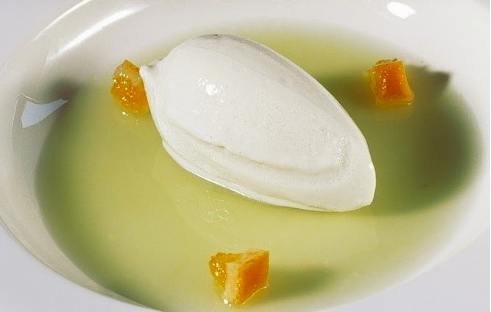
Albert Adrià and Oriol Castro, interested in the discovery, began to grind agar-agar filaments discovering that it could withstand temperatures of up to 85 °C and allowed the preparation of hot gelatins. In July 1998, for the first time in history, a dish with hot gelatin was served, the Roquefort sorbet with hot apple gelatin.
But Ferran Adrià’s relationship with agar-agar did not end there. The El Bulli team began to explore the possibilities of cold gelatin and give it a new vision. Agar-agar allowed them to create sheets of gelatin that they turned into a new “pasta” for their dishes, creating noodles or ravioli with flavors not yet tasted.
After this, agar-agar became one of the basic elements found in any Michelin-starred kitchen.
