


How do we make our agar-agar?
Agar-agar is a polysaccharide obtained from the cell wall of certain species of the genera Gelidium and Gracilaria. It is also sometimes referred to as ‘vegetable gelatin’ or ‘Japanese gelatin’, referencing where this hydrocolloid comes from. It is classified as a thickening additive, with the nomenclature E-406, and its gelling properties allow it to thicken […]
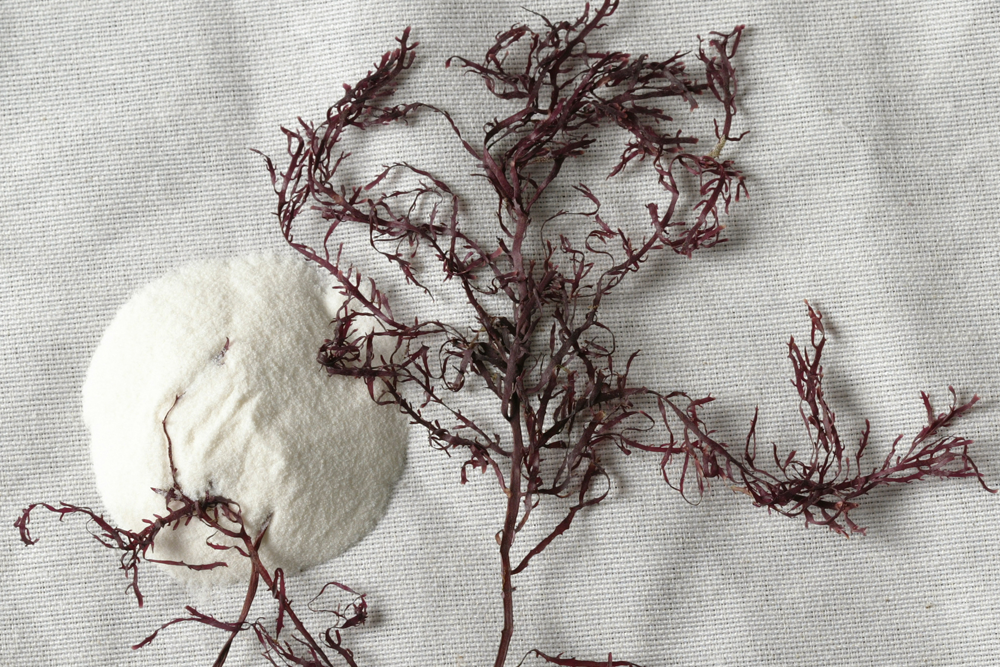
Agar-agar is a polysaccharide obtained from the cell wall of certain species of the genera Gelidium and Gracilaria. It is also sometimes referred to as ‘vegetable gelatin’ or ‘Japanese gelatin’, referencing where this hydrocolloid comes from.
It is classified as a thickening additive, with the nomenclature E-406, and its gelling properties allow it to thicken some products without altering their color, smell, and taste.
Agar has many uses in different industries and sectors, and as we mentioned in our post ‘The versatility of agar, the expanding ingredient‘, its most widespread use is in the food industry, being used as a thickener in dairy products, confectionery, and bakery, sauces, etc.
The steps followed in the agar extraction process are:
-
Once the algae are collected, they are left to dry in the sun or by mechanical means to be stored without undergoing fermentation.
-
Once they are required as raw material, they must be properly washed to remove any marine residue such as mollusks, sand, and small algae.
-
When they are completely clean, they undergo a cooking process with appropriate temperature and pressure conditions so that the agar migrates from the interior of the cell wall to the water.
-
Once we achieve this, the next step is to filter the agar solution in water to remove all impurities, and then the solution is cooled until a gel is obtained.
-
This obtained gel has a very low concentration of agar, so we remove as much water as possible in two ways: through freezing or by pressure.
-
By reducing the amount of water, we obtain thin sheets called papiros, which are ground until a fine powder is obtained. This powder is introduced into the dryer until achieving a moisture level equal to or less than 20%.
-
Subsequently, we sift the agar powder to ensure the homogeneity of the product, and an intermediate batch is formalized that undergoes physical and chemical analysis to determine its properties.
-
Finally, we create a final batch by mixing intermediate batches that meet the characteristics requested by our clients.
