


Ganadores concurso de Arte en Agar ASM 2021
Hispanagar comparte los ganadores del ASM Agar Art Contest 2021, un concurso que fusiona ciencia y arte mediante la creación de obras con microorganismos cultivados sobre agar. Una iniciativa que pone en valor la creatividad científica y muestra la belleza del mundo microbiano desde una perspectiva diferente.
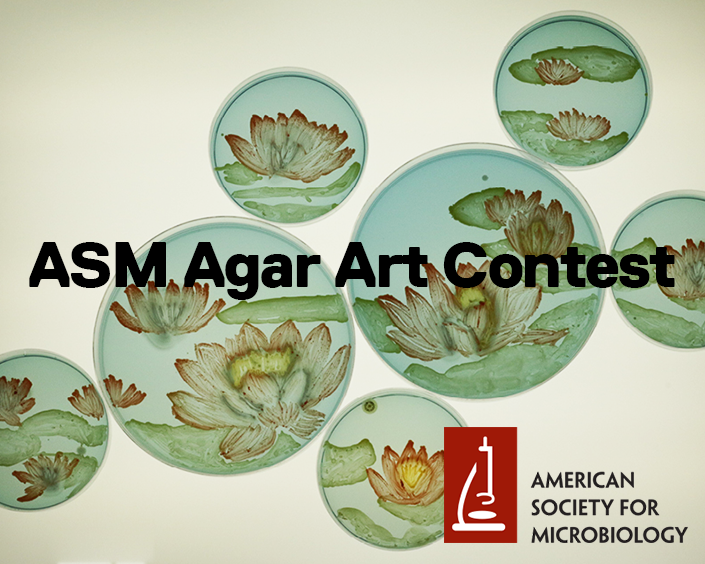
Como ya compartimos anteriormente en otro post, la Sociedad Estadounidense de Microbiología (ASM) lleva a cabo cada año el ASM Agar Art Contest, un concurso donde ciencia y arte se fusionan. ¿Cómo lo hacen? Los artistas se valen de microorganismos de colores naturales, o modificados genéticamente, como “pintura” y utilizan el agar bacteriológico como “lienzo”.
En esta edición han participado 300 obras de 34 países inspirados por el tema “los microorganismos son hermosos”. Existen tres categorías posibles: Tradicional Profesional (participantes que crearon su cultivo en un entorno de laboratorio formal), Tradicional No Profesional (trabajos de entorno informal) y Abierta (obras que utilizaron cualquier medio).
Este ha sido el medallero de la categoría profesional:
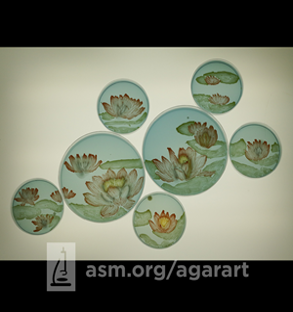
1º lugar: “Microlirios” por Sonja Borndörfer, Norbert W. Hopf y Michael Lanzinguer, Alemania.
Microorganimos creciendo en placas de agar con deficiencia de lactosa, cistina y electrolitos. La apariencia anaranjada se consiguió usando la bacteria Rhodococcus rhodochrous y las almohadillas verdes aplicando al agar una solución de agua estéril y Micrococcus luteus.
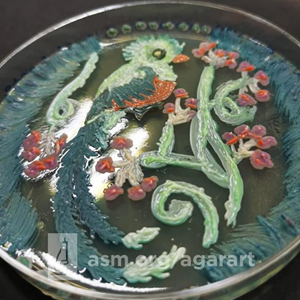
2º lugar: “Plumas de Guayacán” por Marlene Luengas Bautista y Yanet Trovar, México.
Destacan los colores del plumaje y la alteración del color de su cuerpo en función de la luz. Se observan tonalidades verdes, azuladas, esmeralda y un deslumbrante pico de color amarillo.
.
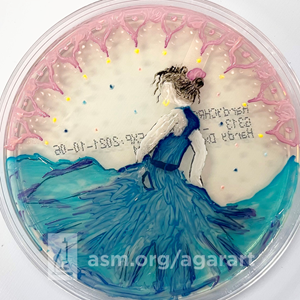
3º lugar: “Fiesta Flamenca” de Mireya Duran, Texas.
Para la falda se ha utilizado Klebsiella pneumoniae y Enterococcus faecalis, la piel se obtuvo a través de una mezcla de Candida albicans y Staphylococcus aureus. La rosa del pelo es Staphylococcus saprophyticus y los pendientes con forma de aro se consiguieron gracias a Micrococcus luteus. Los rizos del cabello están compuestos de Salmonella enterica.
En septiembre de 2022 se abrirá la inscripción para la edición de este año, estamos deseando ver lo próximos ganadores.
